Showing posts with label benchmark. Show all posts

Wednesday, October 26, 2011

Performance of Parallel Migrate-n on Linux cluster


Introduction

Migrate estimates effective population sizes and past migration rates between n population assuming a migration matrix model with asymmetric migration rates and different subpopulation sizes[1].

Experimental environment

In this experiment, the performance of serial version, which runs on single core, is measured as a basis of comparison. Then, the number of core is increased to 8, 16, 32, and 64. Each compute node has two quad core 2.8Ghz Intel Xeon X5560 processors based on Nehalem architecture and 24GB DDR3 DRAM with 1333Ghz clock cycle[2].

Since each compute node has 8 cores, 8 compute nodes are required for 64 core job. parmfile.testml is used as an input file for experiment. The only change made to it for this experiment is that value of menu parameter is changed to ‘NO’ to be able to run it in batch mode on EOS and HYDRA[3][4][5].

Results

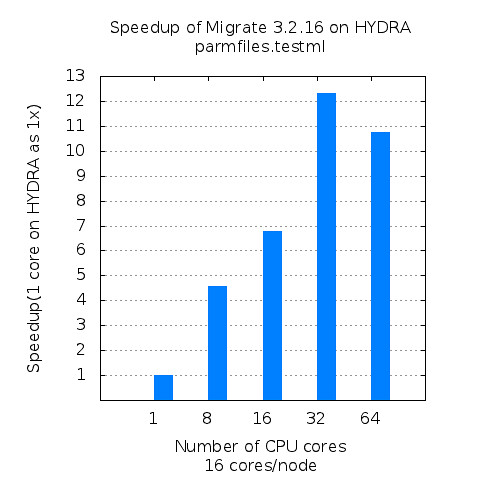
Migrate keeps improving its performance up to 32 cores on both HYDRA and EOS[Fig.1].
[Figure 1]

However, with 64 cores, performance starts falling on HYDRA[Fig.2] and it does not perform better than 32 cores on EOS[Fig.3].
[Figure 2]

[Figure 3]

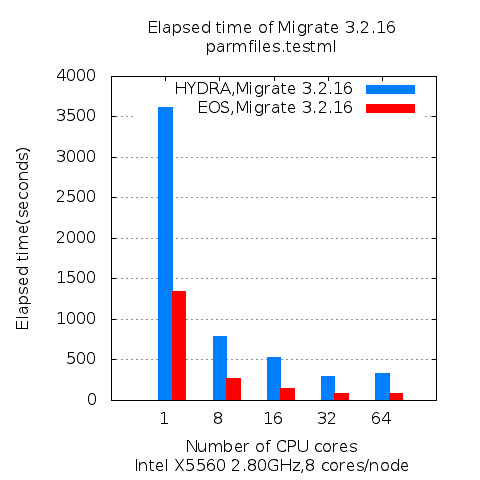
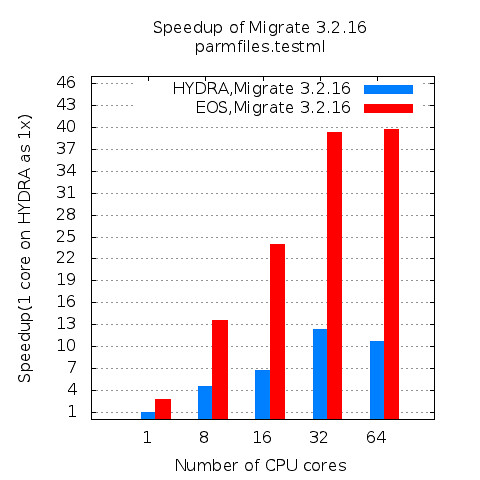
On EOS, 8 cores show 5 times faster than 1 core. There is almost no speedup between 32 and 64 cores. On HYDRA, 8 cores bring 4.5 times speedup compared to 1 core. 32 cores show best performance and 64 cores are a little bit slower than 32 cores.
[Figure 4]

Migrate runs more than twice faster on EOS than on HYDRA in general. With 8 cores EOS is about 3 times faster than HYDRA[Fig.4].

References

1.http://popgen.sc.fsu.edu/Migrate/Info.html
2.http://sc.tamu.edu/systems/eos/hardware.php
3.http://sc.tamu.edu/help/eos/batch/
4.http://sc.tamu.edu/help/hydra/batch.php
5.http://sc.tamu.edu/systems/hydra/hardware.php

Tuesday, May 18, 2010

Scalability study of StarCCM+ on cluster

Introduction

Latest version of StarCCM+ starts supporting multi nodes job on POE/IBM/AIX environment. Previously, it was not possible to run StarCCM+ on more than one node in parallel. Therefore, the maximum number of cores is limited to 16 on hydra[1]. But, with StarCCM+ ver 5.02, it became possible to spawn parallel processes on remote compute node through POE parallel environment on IBM cluster. Now, the question is how scalable StarCCM+ is?

Experimental environment

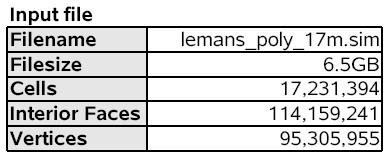
For experiment , lemans_poly_17m.sim file has been tested, which is one of simulation input file frequently used for benchmark. The file size is 6.5GB and it has 17 millions of cells and 95 millions of vertices.


The primary purpose of experiment is to identify how scale StarCCM+ is on hydra, however, the relative performance of two different machines is also evaluated. Each compute node on eos[2] has two quad core Intel X5560 based cluster and each node is connected via Infiniband, whereas, compute node on hydra has 8 dual core Power5+ and HPS is used as a interconnect.


Results

The benchmark results are evaluated from two different perspectives; scalability, relative performance.

Scalability

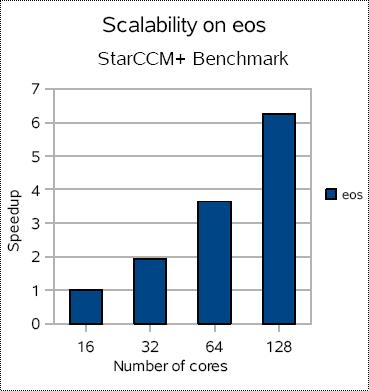
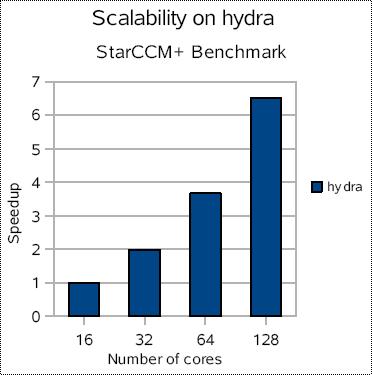
The scalability on eos and hydra shows not much difference each other. The performance with 16 cores is used as a basis for speedup comparison.

On eos, speedup is easily doubled as the number of core increase and it stays very scalable up to 64 cores. With 128 cores(8x), it slows down and shows only 6.2x speedup.


On hydra, it shows very similar result and stays very scalable up to 64 cores and starts slow down around 128 cores.


Based on this result, there is no significant difference on the scalability of StarCCM+ on eos and hydra. However, it could be changed with different input files, I/O patterns, and characteristics of data in input file.

Performance

The definition of 'performance' here is, simply, who finish simulation fast. With same input file, how long it take on each machine? The differences between eos and hydra varies as the number of cores increase. eos is about 2.51x faster than hydra on 16 cores and 2.41x faster on 128 cores.


Conclusion


Benchmark results show that eos performs better than hydra to run StarCCM+ with given input file. However, the differences in hardware specification between 2 machines such as L3 cache size, interconnect, number of cores per node, can change the result with different characteristics of input file.

References

1. http://sc.tamu.edu/help/hydra/
2. http://sc.tamu.edu/systems/eos/hardware.php